Showing posts with label change. Show all posts

Tuesday, June 16, 2015

On Design Language Systems 01: IBM

One of my key professional activities is writing and designing brand guidance systems for companies and organisations. It has been a pillar of my practise for over twenty years. So I have spent a lot of time thinking about how to help people understand their organisation’s visual identity systems, use them effectively, improve them logically, and extend them thoughtfully.

Spread from Manuals One. ©Unit Editions.

As a corporate design aficionado, I have enjoyed spending many evenings pouring over esoteric design details in my copies of Unit Editions’ handsome publications Manuals One and Manuals Two. These two books, reproducing a rich selection of corporate design and identity guidelines from 1963 through to 2008, are an unrivalled design reference resource.
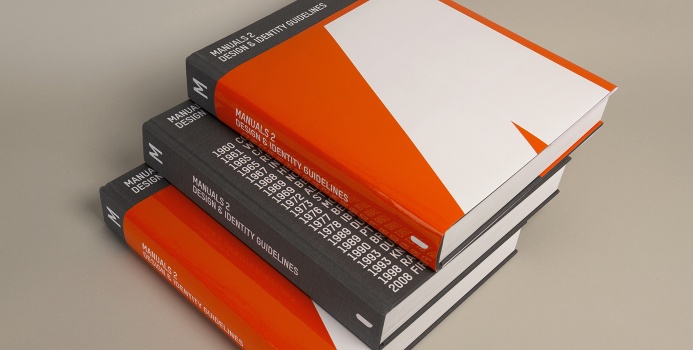
Cover of Manuals Two. ©Unit Editions.

However, examining the requirements of corporate design from the sixties and seventies inevitably got me thinking about the differences in how organisations use design today. At the simplest level, the underlying principles of corporate design still stand; while many of the various technologies of production, manufacture, and distribution have altered significantly, evolved, or have been replaced completely. At the more profound level, it is the ways that companies operate, organise themselves, deliver their services, and communicate with their customers, that have all changed most fundamentally in the last fifty years.

So it is worth asking whether the existing forms of design and brand guidance have kept pace with the ever-changing nature of the commercial entities which are their subject matter.

That line of thinking eventually leads one to enquire: what should designers strive to give as the most useful design guidance for the ever-increasing scope of digital expressions which are central to all experiences delivered by today’s organisations? While organisations will always require some form of brand guidance, I no longer think that itself is sufficient any more. I believe that the most interesting organisations today are having to evolve a more valuable approach of also defining their overall design experience frameworks. These frameworks are more all-encompassing than traditional brand guidance systems.

Four Design Language Examples

I think it is worth investigating some examples of the novel kind of design experience frameworks that I have in mind. These four organisations have each addressed different aspects of the overall corporate challenges to be expressed by design. They form a useful basis for study as they have made much of their design experience framework systems available online. These four sites are all rich in information and each is well worth delving into.

— IBM Design Language
To establish a unified digital experience across many digital products delivered by one global organisation.

— Google Material Design Framework
Towards a consistent digital user experience across many digital products delivered by multiple organisations, (but stewarded by one).

— BBC Global Experience Language
To establish a shared framework for a widely diverse range of content delivered by one global organisation.

— UK GDS Government Service Design Manual
To establish a shared framework for the digital delivery of a whole country’s public services.

(I like the elegance of IBM’s term ‘Design Language’, and will use that for the rest of this article.)

For the multinationals who are now the prime exemplars of these new corporate Design Languages today there are also larger strategic imperatives driving their investment in building these sorts of design systems. As such, their Design Language initiatives are just one strand within those organisation’s broader coordinated strategies: addressing their pressing need to engage with, and leverage, design far more seriously than before. (And also their equally important need to be seen as doing so.)

About Design Languages

The parameters of each Design Language depend on the characteristics of the each organisation’s products or services. For some organisations their Design Language would have more of a visual design emphasis. For others it would primarily address experience design, and for another group it would focus on digital design.

It is important to observe that all of those novel Design Language systems are discrete, and each is separate from their organisation’s brand guidelines. That point may seem somewhat nuanced, but awareness of that distinction is key to understanding the value that is unlocked by such Design Language systems.

Design Languages are primarily about designing the experiences of using an organisation’s products or services. They do not concern themselves with how an organisation communicates, promotes, explains, and sells what it does. Brand Guidelines are about designing those messages and communications around the products and services. The Jobs-To-Be-Done of these two complementary systems are different, so their incentives for excellence diverge.

So comparing them would be of little value. However, I think there is something to be achieved in exploring some contrasts between these two classes of organisational systems. My own professional experience primary concerns brand guidance systems, and my dissatisfaction with their inherent limitations has lead me to investigate Design Language frameworks.

Not every organisation has the need for a Design Language system. In contrasting Design Languages with brand guidance systems, I think that a critical, almost philosophical, difference is that a Design Language must start from the basis that everyone agrees that *design is what the organisation does*. If an organisation’s culture excludes that shared belief, then agreeing upon any shared Design Language is not relevant. Therefore, one significant issue to be aware of is that building any Design Language inevitably requires decisions about how broad or narrow an organisation’s definition of ‘design’ truly is.


Some thoughts on IBM’s Design Language

Starting with the first of the four organisations on my list, I have familiarised myself with the IBM Design Language system. Introduced in 2014, this is a significant organisational effort to collect a corpus of the essential principles of design that apply to IBM’s customer’s experiences of using all IBM products.

IBM delivers hundreds of products with a global organisation of around 380,000 people. Given that IBM is now building a substantial internal design function and is hiring ambitiously to populate that division, it needs a cohesive design system to operate at a global scale, and at the pace of the Internet economy. Explaining the reasons why design has become such a priority now, at this particular point in the lifespan of a one-hundred-year-old organisation, is beyond the scope of this article. For an insightful overview of their design vision and priorities watch this presentation by Phil Gilbert, IBM Design’s General Manager, at this year’s IBEC ‘Better Business By Design’ Conference here in Dublin.


IBM’s new Design Language system aims to bring a renewed focus on human-centred, empathic thinking to what has been an engineering-driven culture. This is now a critical corporate imperative in today’s world, where it is the experience of using digital products and services that is delivering true competitive advantage, more-so than brand reputation or authority. This has not traditionally been the case in the Business-To-Business sectors IBM operates within, but has now become one of the critical metrics for success.

A feature graphic from the IBM Design Language website. ©IBM 2015.


IBM’s Design Language is evolving. It cannot remain static. Their online Design Language resource records the current state of what has to be an ongoing dialogue within IBM. As IBM’s brand guidelines are tools for certain internal audiences, such as marketing managers, and external design and advertising agencies; so their Design Language is a shared framework for IBM’s designers and developers to build the organisation’s products. As such, IBM have structured their Design Language into four sections on Experience Design, Visual Design, Interaction Design, and Front-End Design.

A feature graphic from the IBM Design Language website. ©IBM 2015.

IBM’s Design Language does not instruct their designers how to achieve any particular desired design outcomes, rather it provides a shared conceptual framework. The system is primarily concerned with outlining their high-level design principles and is not intended to be an exhaustive explanation of every aspect of design. (IBM has an ever-growing cohort of trained designers on staff, who will be carrying such design fundamentals around in their heads.) So it is not a suite of integrated design elements providing libraries of digital assets and resources, like Google’s Material Design. Nor is it an out-of-the-box design toolkit, such as Twitter’s Bootstrap. Yet, in publishing most of their framework online, they have also expressed greater ambitions for its wider adoption outside of IBM.

My reaction as I read through the IBM Design Language site was that, although it is already a large corpus of information, I initially thought it was perhaps too high-level and lacking in specifics. In many paragraphs, the authors could have extracted every single sentence to serve as the title for a sub-section detailing how to deliver on that specific statement or goal. However, when I had read and absorbed everything, I understood how their intent was not to specify the answers to all design problems with a toolkit of detailed design patterns. Rather their goal seems to be build an extensible framework which they can improve and refine over time with further inputs as IBM’s designers apply it to ever more real-world products and services.

A feature graphic from the IBM Design Language website. ©IBM 2015.

The significant focus of the IBM Design Language is on design-for-use. They aim to build products which serve as tools that make their customers more effective and efficient. One relevant quote from their framework is that: “a design is not done until a person interacts with it.”

An important outcome of keeping their Design Language at a high-level is that aspects of the IBM Design Language can also inform design thinking. So the organisation can apply their core design methodology to many types of business use cases.
“To emphasise how Design Thinking is not solely about visual design, IBM have used this approach with internal teams creating APIs. In the case of an API there is no UI at all.” 
‘IBM Design: Think before you speak’ – Creative Intellect UK

Additional benefits of developing a Design Language

The key benefit derived from the effort expended in defining a Design Language lies in the organisation’s enhanced design output. That said, they also seem to deliver ancillary benefits as well.

One benefit of a Design Language is as a tool which sets a baseline for all design conversations and feedback within an organisation. Some of its utility must arise from the act of taking certain aspects of design discussions off the table. It must allow the organisation’s design leadership some additional leverage when having the kind of conversations that start like this. “Today we all need to focus on this specific aspect of this design challenge – as our high-level design principles are already in place and so are not for interrogation as part of this project.” Brand guidelines also play the same internal management role for communications design projects.

I can see Design Languages also providing better organisational focus through educating internal clients; by better explaining aspects of what designers do. So that, when evaluating design work, internal clients can hopefully display a greater understanding of the various strata of thinking underlying the design decisions being reviewed. Considering Design Language frameworks through that lens, then they do not need to be exhaustively comprehensive. (Any expanded encyclopedic version, if it was ever to exist, could be a dedicated resource for the organisation’s designers alone.)

Language-In-Progress

The defining characteristic of all Design Languages is that they are never finished. They are an artifact of an ongoing conversation that each organisation is always having with itself. As such, rather than being outsourced to external design agencies or brand consultancies, the onus is on organisations to develop, manage, and steward their own Design Languages. The organisation needs to own design.

The macro-trend of the resurgence, increasing relevance, and importance of in-house design departments is a significant topic I have addressed in previous posts and will return to again. John Maeda recently published an insightful contribution to that ongoing discussion: Why Design Matters More than Moore’s Law.

The potential of Design Languages

The theoretical ideal of an organisation’s brand guidance system is as a platform for establishing a complete, coordinated, and coherent suite of messages, communications, and brand experiences. It must strike a fine balance between the quotidian, tactical, operational requirements and the long-term vision and goals of the organisation.

Unfortunately, in practise, many brand guidelines become used politically. Rather than opening up the complete range of possible expressions within any brand framework, they can become more focused on limiting options. Effectively, they become used as one mechanism to corral the divergent incentives and strategy taxes which exist within the organisation’s power structures. Robert Jones, the Head of New Thinking at Wolff Olins, has written about this limitation of brand management in companies lacking a shared unity of purpose.

It most likely may be naive to imagine that corporate Design Languages can deliver on some of the ideals which brand guidance systems still struggle to achieve. Particularly given that such design initiatives are inevitably subject to the same organisational political forces that influence brand management activities. Yet perhaps the fact that Design Languages have user-centred mindsets embedded within their foundations may make them less prone to being undermined by organisational priorities.

To me the most interesting aspect of the potential of  Design Languages lies in applying design thinking, methods and insight to the core of what organisations do as opposed to what they tell people about what they do. Writing as someone who enjoys problems requiring systems-thinking solutions, I am fascinated by the intellectual endeavour involved in developing a complete Design Language. It is a significant challenge; one I would relish contributing to.

Home page for IBM’s example designs section. ©2015 IBM.

Friday, November 14, 2014

A Future For Designers — Expanded and Annotated

We all know that we need to innovate. But which of the different classes of innovation should we expend our best efforts on? That choice effects the kind of futures we shall build. What novel roles could designers play within those futures? If it is not going to be what we expect or desire, what can we designers do to future-proof our careers?


That was the description of my presentation to yesterday’s Defuse Dublin event. I had to condense my message dramatically to fit into the five-minute Petcha-Kucha format. I hope that posting this comprehensive version here along with source material links will prove useful to all those interested in this topic.


I am interested in what it will mean to practice as a graphic designer in future. Not in the far-flung future; but within the span of our own career horizons. It is too easy to think about what is happening in graphic design this month, or what is coming up in the next quarter. Sometimes it is worth taking a longer-term view. Thinking about what changes lie ahead for the design sector; for the overall role of graphic designers; and in the professional activities of individual designers in five, ten or twenty years time. While acknowledging that such futurology contains elements of guesswork, we can extrapolate from existing trends. The workplace of the future will look different to that of today, and most likely entirely different to that of just a decade ago.


So, what trends are potentially coming down the line that are work thinking about? Automation is not a topic we discuss much within the design sector. In a real sense many aspects of knowledge work and creative work can eventually be automated. This is the prospect facing all white collar careers in all economies. Watch the fascinating documentary ‘Humans Need Not Apply’. Its key messages are:
  • That automation does not need to be perfect — it just needs to be better than most of us, most of the time.
  • That automation is not bad — it is simply inevitable.
I will accept that film is somewhat apocalyptic. But, if we can get past immediately dismissing it as being of little relevance to the creative economy, it does offer us much to think about. It is not only taxi drivers who need to be concerned in the face of automation. We graphic designers are not protected in some unique creative sector bubble.

Walter The Wobot ©2014 Rebellion.
Over the last thirty years technology has disrupted and depreciated the roles artworkers and typesetters in the design sector. Throughout the nineties many of those people’s careers migrated to being aspects of graphic designer’s job descriptions. Now it  looks possible that many of those design tasks will migrate further on to various forms of automated algorithmic technology.


A lot of my day-to-day activities involve writing and designing corporate identity systems. Essentially that is creating design languages and visual grammars for organisations. This establishes a coherent framework for other graphic designers to create within.

Corporate identity manuals are transitioning from nouns to verbs. They began as hefty physical publications and evolved through PDFs to become online resources. Soon they will become APIs.

One can think about corporate identities as high-level pattern languages with many iteration potentials. Unfortunately for some, quite a lot of everyday graphic design work is based on understanding, manipulating and re-purposing of such pattern languages.

Africa books montage by Simon Stevens.
What would be involved in designing another cover for a new book about Africa? Or perhaps creating the icon for a new To-Do app? If we believe that these – and many similar graphic design tasks – cannot ultimately be automated to a greater or lesser degree, then it is likely that we are fooling ourselves.


Such graphic design automation will begin with the design of relatively structured and formulaic materials. It will not begin by automating high level ‘creativity’ per-se. That said, rather than being science-fiction, or the white-paper aspirations of professional futurists, this is already possible.

At a simple level, consider the fascinating service: ‘Paper-Later’. This merges a read-it-later-style bookmarking app with the automatic layout of personal, customised, physical newspapers, printed and posted to you. Do these newspapers have a rudimentary and limited design layout? Yes, of course they do. But remember this is how disruption starts: at the simplest, almost trivial, level. Which is easily dismissed by the incumbents.

It is likely that the relationship of post-human algorithmic design to the accepted Canon Of Significant Graphic Design will be as the musical output of Pop-Idol is to, say, The Beatles. But, in many situations, it will provide the minimal viable solution. Design elitists may wail and gnash their teeth and rend their garments, but the pattern of disruption has been well mapped-out for all industries at this stage. It seems improbable that graphic design would prove to be the exception.

It is notable that IBM’s Watson has already proven its prowess at answering natural language questions. It won the US game show ‘Jeopardy’ and already supports medical professionals in making treatment options for their patients. So automation can already win game shows, compose music and write news articles. But are many of the human skills supporting advanced Design-Thinking too complex for any artificial intelligence software to handle?


We designers pride ourselves upon being creative thinkers who imagine novel solutions for a living. So it should not be a stretch for us to imagine creative algorithms which could design as well as the average designer today. Now, I am no AI research scientist. But for tonight, I have sketched out this quick wire-frame of a rudimentary ‘Design-O-Matic’ algorithm in my notebook.

I am an early-adopter and an anti-Luddite. So I am not discussing automation as a negative phenomenon, more as an inevitability. The correct response to the ‘Lump Of Labour’ fallacy has always been that new innovations open up new roles and free people from less skilled tasks to pursue higher callings. Yet, many experts are concerned that things may not pan out that way, this time around.

Read more: Lump of Labor: Certainly a Red Herring, Albert Wenger, 2014.


So, bearing all of that in mind, we need to ask ourselves: how many graphic designers will actually be needed in the future? And what kind of careers will they have?

The premise underpinning the related future theory of the ‘Gig-Economy’ is that all knowledge workers or members of the creative classes who do succeed in retaining a career shall have no choice but to operate as On-Demand, Super-Specialised, Free Agents serving the tiniest niches within a frictionless, Internet-enabled, global economy.

The most unnerving aspect of that future scenario is that only a small percent of the global population will be smart enough for the level of careers remaining. Ergo, only an equally small percent of the designer population will be smart enough for the remaining creative jobs. Will there be one-percent who provide the novel design solutions which provide the stimulus material for the other ninety-nine percent?

In such a scenario, the critical question then is whether the design-related jobs which are displaced by technology can be replaced at the same rate by those Gig Economy careers? (And how long before someone brainstorms a working business model for the Uber for Graphic Designers? Or even one for brand consultants!)

Learn more: Exponent podcast, Ben Thompson and James Allworth, weekly .
Read more: Airbnb CEO Spells Out The End Game For The Sharing Economy, Venture Beat, 2014.


In our personal response to all such speculative futures we can choose to be fatalistic, or to be excited and inspired. For many graphic designers our future is going to have to be less focussed on design-craft skills. If automation will not displace those jobs in the near-term, then it could be off-shoring, or the ongoing democratisation of design via smarter tools. All those forces are already acting on the graphic design sector.

But it is not all bad news.

Paradoxically, at a time when some designer’s careers will face their greatest challenge, there is also a potential upside for others. There is a parallel narrative of new opportunities for those designers who are prepared to reinvent and reorientate themselves with new mindsets, and in new roles. It remains an open question what proportion of graphic designers will have the appropriate levels and forms of creativity required to succeed within these new economic landscapes.

Read more: It is OK to Worry about Work, Albert Wenger, August 2014.

Illustration by 
One of the traditional career trajectories for designers has been to devote less time to their graphic design craft skills and more to developing their soft skills in consultancy and client advisory roles. Those trust-based roles should prove less amenable to automation in the medium-term. The disciplines of Service Design, Experience Design and Design-Thinking are examples of horizontal activities that broaden the scope of designer’s activities and roles.

Within the graphic design sector the practice of entrepreneurship has traditionally been limited to setting-up design studios. Most those have been lifestyle businesses and SMEs, and rarely economically significant enterprises of scale. Of course, starting such service agencies is entrepreneurial. But what about the designer’s role being neither that of a service-agent nor an advisor? What about designers taking on more of a true leadership role as drivers of innovation?

Wired magazine claimed that fifty percent of startup founders have engineering backgrounds with only six percent have design backgrounds. Most graphic designers have a maker’s focus on building their expertise in their craft. Or at least that is where they tend to start from in their careers. The personality-type of an entrepreneur is characterised as not being expert at any single discipline — except leadership. They have to be ‘good enough’ at many different disciplines and know when to delegate. Yet, both entrepreneurs and designers have skills in iterating and problem solving.

It is striking that 60% of Fortune-500 CEOs cite ‘creativity’ as the most important quality of leadership today. To me that suggests that we graphic designers need to broaden our conception of success. About one-third of today’s Fortune-500 CEOs have engineering backgrounds, rather than pure business backgrounds. What if, in future, one-third of such CEOs had design backgrounds?

Read more: The Economist Special Report: Technology Is Not Working, October 2014


We can observe that — as the value in many products and services migrates upwards to the experience level — design-thinking skills are now deemed critical, valued, and sought-after. In recent years the international business and technology media have started reporting more frequently on the value that designers now bring in setting the agenda and leading organisations.

This narrative is that designers are amongst those best placed to capitalise in the future economy by focussing more on creative thinking and problem solving.
“Over the next few decades demand in the top layer of the labour market may well centre on individuals with high abstract reasoning, creative, and interpersonal skills that are beyond most workers, including graduates.” 
Read more: Silicon Valley's New Secret Weapon: Designers Who Found Startups, Fast Company, 2012.
Read more: The Interface Layer: Where Design Commoditizes Tech, Scott Belsky, 2014.
Read more: Why VC Firms Are Snapping Up Designers, Fast Company, 2014. 


The role of the ‘Designer-Founder’ is a notable new career path. This is someone who uses her design-thinking mindset and problem-solving methods to build businesses that are far more ambitious than service agencies. The challenges within the problem-spaces that many startups are starting to explore now benefit dramatically from experienced design-thinking. The time is right. The opportunity is now and the need is there. No-one is arguing that designer-founders are better than founders with technical or business backgrounds. Rather they complement each other.

Read more: Advice for Designers Who Want to Be Founders, Eoghan McCabe, 2013.


A relevant question to ask is what proportion of graphic designers do have these kinds of leadership aspirations? The answer is now more than has ever been the case before.

That said, it now seems probable that an ambitious cohort within the graphic design sector will decide it is economically most advantageous to abandon the artisan career path or the professional-service career path and step up to the founder career path. Indeed, there are already historical precedents for this type of industry-wide phase-change, most notably in Engineering.

So it is informative to note that incubators only for design-founders are appearing in the US, along with some dedicated venture capital funds such as ‘DesignerFund’. Initiatives like the experimental designer school ‘30-Weeks’ are pioneering the approach of equipping designers with the skills needed to start enterprises, after years of trying to teach startups about design.

We should ask ourselves what potential there is for similar initiatives here in Ireland?

Read more: 30 Weeks: An Experimental New Design School, Backed By Google, Fast Company, June 2014.
Read more: Google Funds a Design School That Works Like a Tech Incubator, Wired, June 2014.

Airbnb’s  Brian Chesky & Joe Gebbia, Pinterest’s Ben Silbermann & Evan Sharpe, Path’s Dave Morin, and Tumblr’s David Karp. 
Looking internationally, there are already examples of high-profile, market-disrupting companies whose founders have design backgrounds. I am sure you are all familiar with Air-BnB, Pinterest, Path, and Tumblr.

No-one argues that Designer-Founders are better than founders with technical or business backgrounds. Rather, that they complement each other.


Some VCs even claim that the core of start-ups has evolved from an ‘Engineer plus Hustler’ partnership. The new ideal is a trio of Engineer plus Designer plus Hustler.

I think it will be interesting to observe how different the priorities of organisations led with a design mindset will be in comparison with those led by a Technical mindset. Perhaps Designer-Founders will envisage and build a different kind of future to complement the visions of technology founders?

Intercom’s Eoghan McCabe & Des Traynor, SeeSearch’s Hilary Kenna, Thoughtbox’s Cristina Luminea, and Drop’s Zachary Davison, Ben Harris, Jonny McCauley & Jack Phelan.
While that trio startup model is now unexceptional on the US West Coast, Designer-Founders are still only a niche here in Ireland. But we are seeing some home-grown Irish startups with designers taking on key roles in their founding teams. While many of these are just out of incubator stage, there are certainly a few we can learn from.

Read more: Find Your Niche And Put Focus On Design, The Irish Times, November 2014.


How is the Irish third-level graphic design education sector grappling with these ideas and economic imperatives? The colleges will have a key role to play in encouraging and transmitting the entrepreneurial aspects of design thinking to the graphic designers of tomorrow. Have they started planning for these futures? Their critical challenge will be that colleges need to foster such entrepreneurial mindsets while they have been configured to graduate graphic designers with an agent mindset.

Ten years ago I attended a talk by Professor Christopher Frayling. He praised what he thought was the under-rated calling of being an “everyday graphic design tradesman”. He argued that educators need to realise and accept that not every student is going to be an iconoclast, a paradigm-changer or a design visionary. He argued educators should be content to train some people to be competent journeymen designers. I do not believe that is a viable strategy any more if we face a combination of automation and a Gig-Economy marketplace.

Obviously third-level design departments cannot just flick a switch and turn on some entrepreneurial acumen within their students. But there is little value in preparing their students for careers that may not exist when they graduate. I spoke with some of the design departments about this. While I found them aware of aspects of these challenges. The slow pace of institutional reaction times and the challenges in evolving their approaches frustrated some of those educators.


So, the future of graphic design work may be far more different than we expect. This third kind of career path will not suit all graphic designers. But, ultimately I think many of us are going to have to realign our mindsets from serving as agents or trusted advisors and step-up to acting as instigators.

The issue then becomes: how do we best prepare ourselves to operate in that capacity?

Read more: What It Takes To Be A Lead Designer At A Top Startup, Designerfund, 2014.
Read more: Linchpin: Are You Indispensable?, by Seth Godin.

Quote from Merlin Mann, episode one of Roderick On The Line.
All this tells me that if you are a graphic designer, you need to work actively on keeping yourself relevant. Ask yourself:
  • What aspects of your work might simply just *go away* in the next five years?
  • Then identify what new areas of expertise you need to start building today.
  • Focus intensely on how you add unique value that cannot be readily replicated.
You need to design the arc of your own career.

Read more: The End of Design As We Know It, Dan Saffer, September 2014. (That post has a lot of crossover with my presentation. I had drafted most of this essay in August and September, before that post was published, but you can imagine how I felt when I read it!)


So, who will be the potential founders, leaders and innovators within our design community in Ireland? Perhaps it is you? Maybe not today, and maybe not tomorrow. But at some possible point in your future career. So do not close the door to that possibility.

No one is going to choose you. Choose yourself.

Postscript 
I think it is important to note that this essay is not intended as an incitement to jumping aboard some happy-clappy ‘Wantrepreneur’ bandwagon. This is not a call to all graphic designers to abandon their craft skills and just release their inner Jobs/Musk/Bezos/Zuckerberg. Obviously, the third career path discussed will not suit all graphic designers. My point is about recognising that there just are not going to be the same amount of artisan or service-agent design roles required in future. So staying active and relevant within the graphic design field may need a broader mindset and a willingness to apply the core abilities of the Design-Thinker to a new set of opportunities.

Presentation Video 
IxDA have now posted videos of all of yesterday’s presentations on YouTube. So here is the live version of my talk.

Acknowledgements
Writing an article like this does not happen in a vacuum. I road-tested some of my ideas, and investigated the background with some knowledgeable people. So my thanks to Valerie Haslam, John O’Connor, Barry Sheehan, Hilary Kenna, Jill Barry, Amy Neale, Conor Clarke, David Smyth, and Shirley Casey for their contributions.

Tuesday, November 04, 2014

Defensive Inertia

As I was distilling and percolating the themes for my forthcoming Defuse presentation, I ended up also considering the different ways we can unintentionally stall our own progress. Think about these three examples.


What’s the problem?
In general I am the person least likely to watch sports-related films. Although 2011’s Moneyball tells a story of American baseball, its theme is really disruption – a topic much closer to my own interests. The film charts the rise of statistical quant methodologies in team construction and player selection.

There is one critical scene where the protagonist Billy Beane confronts the Ancien Régime of grizzled talent scouts responsible for recruiting new players. He explains the true challenges being faced and they summarily dismiss him and his methodologies.

That scene has stuck with me because, whatever business we are in, it is always too easy (in many situations) to gradually fall into the role of that dismissive old guard. As we gain experience, we all develop skills giving us the fast insights, accurate rules of thumb and so-called gut instincts that made those talent scout characters successful in their careers. The danger lies in believing that whatever heuristics have worked for us before will continue to work in future.

However, the true skill is in knowing when the underlying topology is changing and the accepted ground rules are no longer operating. Do not find yourself defending the wrong territory.


Trapped in amber
Last year I attended the screening of the documentary Linotype at the National Print Museum. Many in the the audience seemed in tune with the nostalgic aspects of that film, which was in part a paean to simpler times. When the Linotype machine was introduced it was an innovative and disruptive technology. It allowed newspapers to expand their page counts and frequency of publication. During the era of Peak Linotype, thousands of people were employed worldwide operating those machines. Anyone still capable of operating a Linotype machine today is a novelty: either a nostalgic anachronism encased within an academic/museum setting, or else a decidedly retro design-hipster.

Reflecting afterwards, I think I gleaned a different message from the film than most of the audience. What struck me most was that when Linotype was later overtaken by superior technologies many who had once made successful careers as Linotype typesetters abjectly failed to adapt and make further progress in new or adjacent activities. What would your Second Act be, if the parameters of your industry were to change as dramatically?


Arrested Development
The third idea that I have been mulling over is how the concept of arrested development (loosely interpreted) can apply to our careers. The flip side of attaining high degrees of competency in anything, is that you can blind yourself to your own further potential in greater areas of operation. You can all too-easily define yourself as the person who only does X, precisely because you are one of the best there is at doing X. Yet, you could be even better at Y…

Obviously this poses an ongoing conundrum to all of us throughout our careers. This crosses over with the notion that ‘knowing what you need to know’ is a complex, recursive challenge facing all knowledge workers and members of the creative classes. Merlin Mann has been addressing this recently, both in his Back To Work podcast and in his recent talk Advanced Tricycling at this year’s 34e developer conference.

So a loose assembly of those three ideas was in the back of my mind as I composed my talk ‘A Future For Designers’. I think that the take-away here is that we always need to beware of getting ourselves stuck by defending our own personal status-quo. (Even though we most often do so with the best of intentions).

Wednesday, October 01, 2014

The Future Of Work And The Internet Rainforest

This year Exponent has become my primary must-listen-to podcast. (I am still hugely appreciative of The Critical Path podcast, but it has gradually drifted away from a weekly schedule.) What makes the Exponent format unique, amongst the podcasts I listen to regularly, is that the hosts Ben Thompson and James Allworth usually tackle a topic by taking two different analysis and having a robust debate to dig into the topic and uncover new insights. There is a lot to learn from their full and frank exchanges. I find their probing dialogues to be successful because, in general, they are dissecting the ideas – not the person proposing the ideas. I always strive to live up to the maxim of ‘Strong Opinions, Weakly Held’. So I think it is always educational to see how someone well-invested in one thoughtful analysis can revise their position in a debate that brings new insights to the surface.


Recently I have been doing some investigations around the topic of ‘The Future Of Work’. The twelfth episode of Exponent ‘The Internet Rainforest’ delved into aspects of that topic. To appropriate one of Allworth’s preferred superlatives this particular topic is ‘super-interesting’. There are many significant changes already underway in the way that labour markets are going to operate. With no guarantees of positive developments for the majority.

The aspects they discuss reflects Thompson’s career where he has established a viable niche as an analyst/blogger/pundit/podcaster by cultivating an audience of paying subscribers. They discuss whether the majority of viable careers will have to take similar forms in the future, and how many people shall be capable of operating at the required levels. They develop an intriguing metaphor of an ‘Internet Rainforest’ to represent the extremes within future labour markets: with colossal omni-national corporations above in the canopy and nimble techno-artisans below on the forest floor.

As I have already transcribed selected excerpts from episode twelve for my own notes, I hope that, by sharing them here, others may find them useful as well. I have attributed each quote to BT (Ben Thompson) or JA (James Allworth) and given an approximate time stamp. One disclaimer: I have lightly-edited portions of these transcriptions for clarity, mostly by omitting conversational repetitions.

One of the absolute outcomes of the Internet may be the end of super-large companies. (BT ~19.50) 
If you start a company on the Internet your addressable market is in the billions. So even if your niche is only point-one percent of four billion, it is still a very big number. (BT ~20.30) 
It is like you can longer have super-large companies now because they cannot be large enough any more. (BT ~22.20) 
My thesis is that there is going to be a massive bifurcation between very, very large and very, very small and everyone in the middle will go away. (BT ~23.40) 
I am imagining this Rain Forest with these massive trees, but this interesting canopy down underneath that is growing and harbouring all of this interesting life. But there is literally nothing in between the two. That is the economy that the Internet is creating. (BT ~28.00) 
I am reaching an infinitesimal sliver of the Internet, but the Internet is so huge that it is a meaningful amount. On the flip side: huge sites get more huge. They are reaping the benefits just as well. Meanwhile everyone in the middle, who has neither the focus nor the huge scale, is going out of business. (BT ~28.30)  
What is the future of jobs going to look like? It is going to look messy; just as the Industrial Revolution was messy. However, whenever we do reach that future, it is going to be a more individual, artisanal society. Where people do something super-specific that they are really freaking good at. And they are able to reach a sustainable audience through the Internet. (BT ~30.30) 
[The questions are] how technology is changing the ways people work and where the gains will accrue. They will increasingly flow to a few people who will become really big winners. Folks that are concerned about how the Internet is going to change employment and contribute to inequality are not Luddites. They have identified that something has changed fundamentally in the way that the labour market operates. (JA ~39.20)
Technology increases efficiency. Those efficiency gains accrue to the owners of capital and not to labour. The people who actually do the work, not only do they not make more money, but they are not even needed. That is all basic Marxist theory: but what Marx got wrong was that machines in the time of the Industrial Revolution were dumb and did not take that many jobs. Now machines are smart and just because people were wrong to say machines would take over human jobs previously, does not mean that it is not going to happen this time. Also, it is not like it was super-great the last time. The Industrial Revolution took decades and two world wars to work its way through the system. (BT ~40.20) 
In the Industrial Revolution, the number of new jobs and their value outweighed the number of old jobs that they replaced. So the question is: will that be true again here? (JA ~43.10)  
How fast can we come up with these new types of jobs? And can we come up with them at a rate faster than we are losing jobs to automation? (BT ~44.00)
What is encouraging is that this is a clear call-to-action for how we can meaningfully create the future and overcome those problems. (BT ~44.20)
The longer-term question is: are there potentials for everyone not working inside [a large multinational at top of the Internet Rainforest] to be doing the kind of thing you are doing? (JA ~45.20) 
If you start breaking the seven(?) billion people on the planet into these little niches: are there enough niches to support the vast majority of the world’s population doing these kind of jobs? The skills required have evolved from the Agrarian Age to the Industrial Age onto the Information Age. It sounds like creativity is going to be something that allows people to flourish on the forest floor. Are there enough creative people out there to do that? And if you are not creative what happens to you? (JA ~45.40)
Another way to frame your question is: will the number of niches outpace the gains to the power curve? (BT ~46.30)
In any particular niche there are going to be just a couple of big winners. And so when I talk about the long tail: it is not that there is a long tail within a niche, it is that there are an infinite number of niches. Because, in a particular niche, the whole reason the niche is now possible is that you can reach everyone on the planet. There is going to be the single best person who does X, and if you are the fifth or sixth best person who does X… Well that is where the tension comes in. (BT ~47.00) 
My hypothesis would be that there are going to be plenty of fifths and sixths; and the world we moving towards does not behave too kindly towards them. (JA ~47.30)
Even after the Industrial Revolution the vast majority of people do jobs that they don’t like. This is not a utopian future. (BT ~48.00) 
We started with 98% working on farms. We ended with 2% working on farms. The problem was that industrial jobs increased more slowly than jobs on the farms disappeared. That meant we went through a wrenching change over decades that manifested in all kinds of ways, through economic upheaval and wars. (BT ~49.30) 
When you have a system where things don’t line up temporaly, then you have the chance for all kinds of ruptures and fissures in society. To me that is a clarion call to us in Tech. (BT ~50.40) 
Everything is accelerating. We don’t want to overly pattern-match, So why assume? Just because it took a few hundred years before; it does not necessarily have to take a few hundred years this time. (BT ~51.30) 
If you find the ideas in those excerpted transcriptions engaging, then I urge you to listen to the complete episode here. The other episodes are worth delving into as well (there have been nineteen to date).

Tuesday, June 10, 2014

Is Brand Strength Any Defence Against Big Bang Disruption?


One open question arising from my previous post about disruption and design thinking is whether brand strength (1) provides any potential defence or hedge against disruption?

At this stage we are all familiar with the narrative of true business model disruption. Entire industries, such as travel agents and book shops, have been made made redundant as low-end disruptors reinvented the rules of those businesses within a few short years. For accuracy I will also include Thompson’s complimentary concept of ‘Obsoletive’ technologies which posits high-end innovations that make older technologies obsolete.

For businesses to survive disruption, they need to abandon and completely rethink their long term strategic plans. The old rules no longer apply. As Steve Denning observes:
“Big-Bang Disruption is just one of the more dramatic symptoms of this broader and deeper economic phase change: the emergence of the creative economy, where continuous transformational innovation is the game being played.”
It is trivial to come up with examples where disruptive or obsoletive innovators have destroyed the value of incumbent’s brands (as a by-product of destroying their business).
  • Think of the many mobile phone manufacturers who had built global brands (most spectacularly Nokia) only to have them wiped out in less than five years by the disruptive market entrants iPhone and Android. 
  • The Walkman brand for mobile music was so dominant in its time that it became the default name for a whole product category. All of that brand’s value was destroyed when Sony's internal politics allowed MP3 players to disrupt their business. 
  • Yahoo had established the pre-eminent brand in the area of Internet search before Google arrived with PageRank, an innovative alternative approach to search, and completely disrupted Yahoo’s business. Now Yahoo licenses search technology from Microsoft.  
  • Garmin lost 85% of its market capitalisation in the eighteen months following the introduction of Google Maps.

Counter examples are more difficult to find. What are the relevant examples of businesses under sustained Big Bang Disruption who succeeded in using their brand strength to delay (or avert) their decline?

The disruptors begin by attracting the low-value customers and then capturing more of the high-value customers. So during disruption, the classes of business assets that brand consultants leverage: brand equity, corporate reputation, even customer service experience, all become progressively irrelevant as customers migrate to the disruptor’s better, cheaper products.

My opinion is that Big-Bang Disruptive business model innovation routes around brand strength and makes it redundant. Therefore it is probable that brand strength only operates within markets based on standard competition of similar business models.

So while the methodologies of branding, as currently configured, may not be fit-for-purpose in defending against disruptive business models, it remains an open question as to how one would re-invent or re-orient branding so that it could provide more of an effective hedge against disruptive competitors.

A related question is how then should branding consultants effectively engage with companies undergoing Big-Bang Disruption?

1 — Note on ‘Brand Strength’
Up to now I have been using the phrase ‘Brand Equity’ too loosely in my writing. I became irked by the confusion around that phrase caused by both a vagueness of terminology and a variety of definitions. Kapferer (New Strategic Brand Management, 2008) proposed that brand equity is composed of three aspects: brand assets, brand strength, and brand value. With brand value being “the profit potential of the brand assets, mediated by brand strength”. So, in the context of this article the relevant aspect is the strength of a brand.

Friday, May 02, 2014

Applying Design Thinking to Big Data, Uber-fication, The End of Average and The Capitalist’s Dilemma


An overview of some of the compelling ideas and business innovation themes that are influencing my thinking at the moment.


Over the past year I have been investigating the topic of Design Thinking. I have been documenting some aspects of my explorations on this blog. However, I realised that I had only been considering Design Thinking as a theoretical methodology. Organisations can use its methods to address issues at all scales: from small design problems all the way up to large-scale economic and policy issues. I had not considered any potential challenges worth tackling with Design Thinking.

In my readings of the first part of this year, I have noticed some relevant emerging themes.

  1. The Potential of Big Data
  2. The Impacts of Uber-fication
  3. The End of Average
  4. The Capitalist’s Dilemma

I have selected these four themes for this post, as I think they interconnect, build upon, and influence each other. And also because they align with some of my own areas of interest. There are many other related and relevant themes and trends which I have omitted due to constraints of time.

I am interested in whether and how organisations could use Design Thinking and Service Design methodologies to address aspects of these themes. These are all macro trends and their initial connection to Design Thinking can appear tenuous at first. Yet one other key theme from my readings is that many people now believe that the insights and novel combinations delivered by the application of Design Thinking methods – and indeed by bringing the skills and mindset of professional designers to bear on a much broader range of challenges – should, in some part, contribute to the sort of idea generation, realisation, and implementation that can help organisations address today’s big challenges.

1 — The Potential of Big Data

From my perspective, it appear that we are experiencing a time of accelerating exploration and development of novel business models due to many overlapping actors and factors. Big Data is a global macro-trend that is acting as a scene-setting backdrop and enabler to many novel activities and potential innovations. Consider these sample data points.

• Beyond PC
There are already 7 billion mobile connections held by 3.45 billion unique mobile subscribers worldwide. One billion more people will soon own smartphones in the near future. Each of those devices will create extra data and contribute to the global network.
Read: ‘Postmodern Computing’ on Asymco.com.

• The Golden Triangle of Disruption
Social, Mobile, and Real-Time technologies are all aligning to cause far bigger changes than organisations had ever anticipated. These new consumer habits and expectations are outpacing current organisational structures and fractures. So organisations are having to scramble to catch up, or even just to keep up.
Read: Digital Transformation Report 2014 by the Altimeter Group.

• The Internet of Things
Everything is becoming connected. More and more devices are providing inputs into the network. Google recently spent $3.2 billion acquiring Nest which produces data-enabled devices for the home: such as smart thermostats and smoke detectors. Over 11 billion sensors are attached to the global network today, by 2020 predictions are for over 50 billion sensors. What can we do with the new kinds of knowledge arising from the patterns in all this information?
Read: ‘In Praise of Boring Objects’ by Tom Coates.

What is also intriguing is that, up to now, smartphones have only had rudimentary awareness of their surroundings. The ways that low-cost, low-energy iBeacon technologies are starting to provide an API for the offline world and close the physical attribution loop for online services means that business innovation in that area is only in its infancy.
Read: ‘On The New Edge Network and The Future of Local Commerce’ on Stevecheney.com.

• Smarter Cities
Everything is becoming connected. IBM are focussing on this aspect of Big Data and public services are very invested. Optimising all aspects of city infrastructure both to bring efficiencies in city management and improvements to citizen's quality of life will only become more important as populations continue to grow.

• The Quantified Self
Big Data can also be personal. It can concern our individual health. We can now generate and analyse data that encourages our own behavioural changes. "Big Data is made from Small Data." The Quantified Self is enabled by technologies such as the (just-retired) Nike Fuelband and the iPhone 5S which already has a dedicated motion-tracking co-processor. Indeed Apple are poised to bring take niche activity into the mainstream with talk of dedicated “HealthBook” features coming to all iPhones this year in iOS8 (and with their rumoured wearable product as well).

Big Data is going to spawn many new innovations in business and services. Opportunities that we are only now beginning to imagine. I believe that the Design Thinking mindset will have much to contribute in exploring potential use-cases and implementations, and can provide significant inputs at this inflection point.

But problems and negative reactions also lie ahead when the consequences of hyper-efficiency start to play out in local economies.

2 — The Impacts of Uber-fication

One significant transformative impact on businesses arising from Big Data-related innovations – which we have already entered the early stages of – is the potential for the so-called ‘Uber-fication’ of local-scale economic activities. The new category of On-Demand Mobile Services – apps, such as Uber and AirBnB, that aggregate consumer demand via mobile devices, but then fulfil that demand through offline services – could deliver multi-billion market opportunities.

While this is a technology-driven phenomenon, it would be a grave mistake to view it solely as a technology disruption. This one is going to play out at a societal level. There are two notable effects of this disruption.

On the buy-side, the levels of customisation and optimisation of services for the users is compelling and has delivered competitive advantage. This has already started to re-set customer expectations for many other services. People are becoming accustomed to buying services in ways that the end-supplier may have difficulty transitioning to. Push-back against this disruption ranges from the street level: protestors attacking Uber taxis in France and picketing Google buses in San Francisco, up to formal regulatory and governmental responses.

On the sell-side, certain services are becoming markets. Hailo’s CEO spoke at last year’s Dublin Web Summit alluding to the broader scope of the Hailo/Uber resource allocation business model. In effect, this model is accelerating the migration of many new categories of service providers to more of freelance-based, gig economy. So these models are disrupting the fundamental nature of many occupations. It may be taxi drivers and B&B owners today, but it may well be white-collar professional careers next.

Ring-fencing existing business models, and wishing things would stay the same is never a successful long-term solution. The fact that these dramatic changes to the ways that services and markets relate, and to the ways that people think about services and interact with services, are all happening right now provide many challenges and opportunities for leveraging Design Thinking.

Moving on from the disruption of service markets, let us consider the future of white collar professions and knowledge workers.

3 — The End of Average (or the Death Of The Middle)

One thing the Internet does particularly well is disseminate knowledge. In all markets the addition of knowledge allows for more discernment: we know who is the best and who merely claims to be the best. So the Internet begets Power Law differentiations. Sure, there is a long tail, but influence accrues at the head of the curve. We are only beginning to experience the fallout from the collision of society’s normal Bell curve with the Internet’s Power Law curve.

The global newspaper industry is a topical example. What is happening there is a clarification between ‘news’ and ‘newspapers’, which are not the same thing. (Although for the majority of their existence up to now they had seemed to be.) The previous economic constraints of time and place that always supported mid-tier newspaper titles have fallen away now that everyone more-or-less has access to the best of journalism. Those businesses are failing one after another. We need new business models for new entities – not revised business models for out-dated entities.


So what careers lie ahead for the tens of thousands of journalists who used to occupy the middle of that bell curve? This has huge implications for economies and societies in the long-term.

“Then think about the millions of others in all the other industries touched by the Internet who are perfectly average and thus, in an age where the best is only a click away, are simply not needed?” “The challenge of our time is figuring out what to do with a population distribution that is fundamentally misaligned with Internet economics.”
Read: ‘Fivethirtyeight And The End Of Average’ on Stratechery.com.

Design Thinking is associated with dealing so-called ‘wicked problems.’ I think these themes fall within that category. Addressing issues of those magnitudes needs new thinking. They will requires cross-disciplinary thinking and no single actor will resolve them. So the next question is: has anyone started to chart to path forward? 


4 — The Capitalist’s Dilemma

I think that businesses and policy makers could investigate and engage with Clayton Christensen’s thesis of ‘The Capitalist’s Dilemma.’ He identifies three types of innovations and observes that we are focusing on creating the wrong sort of innovation.

• The first type are ‘Empowering’ innovations. These transform complicated, expensive products that had been available only to a few people before, into simpler, cheaper products available to many. The Ford Model T was an empowering innovation, as was the PC. What is important is that these innovations create many direct and indirect new jobs for the people who will build, distribute, sell and service these products. 


• The second type are ‘Sustaining’ innovations. These replace old products with new. They are necessary to remain competitive against competitors.They keep economies vibrant, but they have a neutral effect on jobs.


• The third type are ‘Efficiency’ innovations. Efficiency innovations almost always reduce the total number of jobs within an industry, by allowing fewer people to complete the same amount of work (or even more work). The problem is that we have become so good creating at such optimising efficiencies without balancing them with new empowering innovations.


(Guess which type of innovations we focus on most within this country?)


Organisations have relied on measures of efficiency that focused on the short term, which leads them to invest in sustaining and efficiency innovations instead of funding the big ticket empowering innovations that pay off over long time frames. 


Over the long-term this pattern is problematic for many reasons. Christensen posits that, to avoid the twin perils of trapping capital in silos and decreasing employment we need to get far better at creating empowering innovations. Easier said than done.


Read: ‘Christensen: We are living The Capitalist’s Dilemma’ on CNN.com.


Aside: while we may not be kickstarting the next Manhattan Project or moon-shot anytime soon, we do need to explore some longer term projects. (What about colonising Saturn anyone?)


The way forward involves innovating our way to growth. Innovation has become a somewhat redundant term through overuse. Horace Dediu has provided us with a useful critical lens through which to parse real innovation from mere novelty.

Read: ‘Innoveracy: Misunderstanding Innovation’ on Asymco.com.

In conclusion

Global, societal, economic and cultural challenges are complex and multi-faceted. They have no single source of solutions. Design Thinking is another toolkit people can draw upon to tackle such looming, large-scale, intractable problems. Its methodologies have application to many relevant and pressing areas of investigation. Organisations, in both the commercial and the public sectors, could benefit by using Design Thinking methodologies and practices to generate and explore new empowering innovations.

Monday, October 17, 2011

Desk


I have worked at this desk for over ten years.

Tomorrow BFK move into our new space next door. I have decided that I am not permitting a lot of my old paperwork, files and other general cruft accumulated over a decade to make that move with me.

Sometimes it is important to let go of the past. Decide what is important and worth taking forward and then jettison the rest.

Time for some new perspectives I think.